
Regular listeners might remember I was at the innov_ex conference at Lancaster University a few months ago. It was a real education, there was an amazing insight into all the factors that shape the outdoor industry far beyond what we get to see in the stores.
I meant to write all this up ages ago, but for a few weeks after the conference all I did was melt peoples heads with facts and information learned on the day, so I thought I’d give it a little distance and read through my notes fresh, and hopefully keep the word-count to something I can read through without abandoning all hope.
Clicking the link on the first line above gives access to news and video coverage of the whole day. It was a long day but it flew by, there were no gap-fillers in the line-up and all the speakers had something worth hearing.
This is my personal persepective and interpretation of the day.
I had dinner with the speakers and various other guests, including Mary Rose and Mike Parsons the organisers, the night before, and that gave me a different perspective that I wouldn’t have had otherwise. I got to hear about peoples lives as well as their work: children, holidays, home, plans were discussed, and opinions were also freely expressed in good humour. People are never one-dimensional, it’s easy to forget that when listening to or reading information. Anyone who spends time on online forums will know how easily things can go awry when blanks words are interpreted in ways other than intended. What I’m saying is that it was nice to know some of the people beforehand, I think it made me more receptive on the conference day, not to believe what they were saying, but to at least listen without preconceptions.

Detlef Fischer, Bluesign Technologies
 Detlef Fischer opened up the show in grand style, with a great presentation and also by talking some sense.
Bluesign is becoming increasingly familiar as brands sign up to it, Patagonia, Vaude and recently Haglofs are among the most familiar outdoor names.
Bluesign study a manufacturers whole operation from the raw materials coming in the door to the boxed product going out of the door. They advise a course of action on how to clean up the process, how to save energy, minimise waste and cut pollution. The detached nature of production means that the factories seem to just carry on regardless, in the west we have chemicals and processes that are a no-go, but in the east there is an element of don’t know, or don’t want to know.
It’s a long involved process, but once in place the manufacturer can say that they’ve reached the standard required and can use the Bluesign stamp, which as time goes on I can see becoming increasingly high profile.
What makes it work for me is the real-world thinking, making the best of a situation, it’s workable. What makes it work for the manufacturers is that once in place the Bluesign regime saves them money. The same factory, producing the same product for less money and waste?
The waste and recycling element was the focus of innov-ex, some figures such as using 700L of water to make 1kilo of textiles were frightening. Now that the manufacturing is half way across the world, the effects are unseen, filthy rivers, toxic air, poisoned soil. It sounds like a Dickens novel, but it’s only a flight away of we want to see it, and the poor sods that have to live in it.
Robert Lomax, Baxenden
Robert Lomax carried on with what was basically synthetic versus cotton, and the information fired out during that was very enlightening.
Synthetic is evil, a product of dirty factories, cotton is lovely, grown naturally in field where birds sing and mice scurry between the plants. No, not even close.
Both poly and cotton are both as much trouble as each other, but the fact that polyester isn’t any more evil than cotton, the notion that organic cotton will save the planet is nonsense and fact that polyester can be easily recycled changes things in my mind.
GM cotton is improving the crop, less waste and better yield, but those two letters “GM” raise as many questions as answers. Cotton is huge business, in carries a lot of muscle in the US. It’s funny how we all accept cotton as being natural, environmentally friendly. It’s a triumph of marketing and myth perpetuation.
They are trying to source polyester from biomass, this will eventually replace the need for crude oil (poly fibres take only 0.6% of crude oil production, if we had hydrogen powered cars the crude would give is fleece ’til the end of time), so it’s good to see research is forging ahead.
Incidentally, Sympatex, the much maligned waterproof membrane fabric is made of three layers of polyester, Gore-Tex is made of three layers of different fabrics. This means that Sympatex can be easily recycled and Gore Tex is easier to stick in landfill. That’ll have to change in the future.
The bottles into clothing label is quite common now, and that whole thing is growing with Teijin taking old fabrics and the like back east from us and making them into new to send back. Much better than sending empty ships I think? Every action has a knock-on effect. Is this the start of a closed loop of resource use, a process where very little new material is used, maybe one day no new content?
Mike Redwood, Leather Futures Research Group

Mike Redwood stuck a pin in another generally accepted “fact”, that leather boots are good and synthetic trail shoes are bad. Turns out that’s rubbish. All the arguments about me encouraging folk to wear trail shoes as being environmentally unsound are without substance. Leather is evil.
Leather has so much treatment in it, chemicals, heavy metals, that it can’t be disposed of properly. Mike had a leather sample that was dug out of the ground where a Tannery was over 100 years ago and it was still supple and well, usable looking. They used to grind up leather and use it on running tracks, but the chromium present meant that this wasn’t such a good idea, and even using “natural” tanning is as bad. There’s so much toxic by-product from any tanning process as well. So you have waste from production and a product that when worn out can’t be used for anything but landfill.
I put natural in inverted commas above as it occurred to me that everything is natural, every chemical or material used has come from this planet, maybe we;ve worked with it, but it,s all natural. Maybe if we viewed science as folk working with nature rather that mentalists creating doom from scratch in a laboratory, we could bridge a gap of understanding, and therefore acceptance, even support of attempts to make advances?
Mike endorses the concept of “Cradle to Cradle”, This basically means taking raw materials, making the product, using it, wearing it out, then breaking it back down into it’s raw materials to start again.
I love the idea of this, but it’s a bit utopian I think. To do anything you need energy, and as it stands we have to consume something to make that energy. Maybe in the future we will have impact-free energy production that will allow the lengthy processes to make Cradle to Cradle work, but until then I can’t see it making as much impact as Bluesign’s real-world approach. Doesn’t mean we can’t plan and theorise of course, and some statements from Mike stuck out: “Instead of being less bad, be more good” an interesting glass half full/ half empty concept, and “Don’t just change small things, reinvent everything”. That sums up the the ideal-world aspect, my first thought was “Aye, but you have to get someone to pay for that”.
Panel Discussion
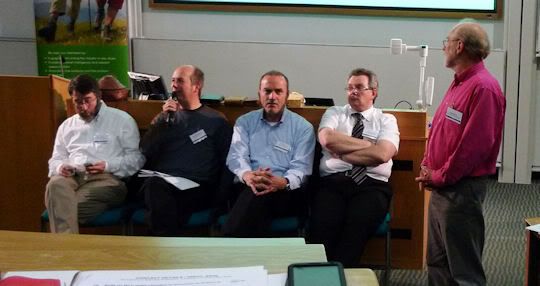
The panel discussion was interesting (check it out on the website), there was some mild and polite disagreement where concepts diverged and opinions clashed. Some questions came in which had reactions from the audience and panel alike, most memorable when Paramo were described as socially rather than environmentally friendly. Paramo and Nikwax were sitting behind me and nearly stood and turned in unison. I chipped in about Montane’s use of recycled fabrics in the current range which seemed to have escaped common knowledge. That’s another point, if you’re playing your part you have to shout louder.
My question was deliberately obscure. Boffins and the like appear to be so focused in the issue, the dilemma and the solution that they completely forget the human link in the chain. There was much discussion about recycling old gear, or trading in for a discount. I know that there’s gear I’ll never part with, and that I’ll never use either. Folk keep (even hoard) kit for sentimental reasons, or “just in case” , you’ll never get folk to recycle everything, you’ll always need raw materials. I got a very blank look from the panel.
Like I said above, realistic and workable solutions are what we need, not ideal-world solutions that rely on everyone playing ball. But, if it was all in place for folk to play along, it was accessible and trouble-free, folk would no doubt get into the notion of putting their old jacket in a bin in their local outdoor shop to be made into one in next years colours. But the industry would have to invest in the infrastructure and advertising to make it work, as indeed Patagonia already have.
I can’t see any of this keeping prices down though, folk are baulking now at the price increases. Will it mean manufacturing shift away from China to cut costs and the whole thing would have to start again from scratch?
Video Conference
Alan Knight OBE & Chris Sherwin
The video conference worked very well, and the interplay was very good, and probably because of that I took hardly any notes!
But Alan Knight and Chris Sherwin know their stuff, being very involved industry so know what’s happening and why, as well as trying to change what’s coming next.
A few things stuck out, saying that “Capitalism is still the only way” was bold, but the case was strong. Money flowing around the world has power, it’s how it’s wielded is what makes it good or bad, not the concept itself. the recession hasn’t halted research and innovation, it’s concentrated minds and galvanises efforts.
Seeing the big picture. That statement made me happy, sit up and have a look around, see your place in the general hubub before you think you’ve solved the problem.
One statement stuck with me, real-world thinking “Join the new into the existing rather than replace”. That’s workable, no scaremongering, no thoughts of huge expenditure, just a notion of bringing in some newness.
Mike Berners-Lee, Small World Consulting

Mike Berners-Lee’s engaging presentation was about carbon footprinting, not as the photie above would suggest, Inov-8’s new 10kg trail shoe. 10kg is how much carbon the shoes produce during manufacture and getting to the shops.
Going back to earlier, it turns out that polyster has half the carbon footprint of cotton. That shows you that it’s not always the visible or easy to understand consequences, there’s always something else, nothing can be seen as a stand-alone problem.
The carbon footprint wasn’t held up as the answer as to what was good or bad, just as an element, again some real-world thinking. So many “environmentalists” harp on about one thing and they’re missing the point as much as those who’re trying to ignore them.
Some interesting fast were that paper towels in public lavvies half the carbon imprint of the electric hand driers (except the high pressure cold-air ones, which incidentally don’t wake up the germs just in time to stick to your hands like the heated ones do…).
Transport is the killer, until we ground aircraft it looks like it’s pointless trying to shave the carbon off elsewhere. Stick all freight and people back on ships and we;ll be better off, and from a personal point of view, maybe it would help to ease the pace of life back from the current frenetic setting. I don’t care if mail order takes longer than 24hrs. We really did used to allow 28 days for delivery.
Innov-ex Prize
 The innov-ex prize is an important part of the conference. The winners have gone onto bigger and better things. Jan-Fahrenheit Betros, the 2007 winner spoke about growing Röjk his own brand of performance wear in Sweden. He now has a range of clothing and accessories, sponsored athletes and is in talk for distribution here in the UK.
Lisa Alberti won the prize last years for her female-specific performance baselayer, something I know is very important to a lot of you out there.
This year there was a female-specific flotation device up for the prize, so it’s encouraging to see that there are designs out there for women in outdoor sports, we just aren’t seeing the manufacturers getting off their chairs readily enough.
The 2009 winner though was Peter Dollman with his indoor technical ice axes. They’re have the now familiar ultra-shaped designs that are used without leashes for sport climbing, but Peter had replaced the head with a fabric wrapped cable loop which can be used on any indoor wall with causing any damage.
The prototype was a lovely bit of kit and they’ll now go into production with Alpkit.
Peter’s there above accepting his prize from Sam Fountain of Sheewee (who’s wearing a Röjk hoody incidentally).
Phil Reeves, Econolyst & Jason Jones, De Montford University

There’s no other way to say this, but the last part of the day saw us taken into the realms of science fiction. All I could think of was a replicator from Star Trek, or Jeff Bridges getting rebuilt bit by bit at the end of Tron.
At the top of the page you’ll se a locking carabiner, and just above are a pair of lace locks for people who have difficulty with their fingers, such as arthritis sufferers.
The white plastic locking mechanism and the laces locks were printed. The simplest way to put it is it’s an inkjet printer, but rather than ink it uses plastic or metal grains and passes backwards and forwards creating a three dimensional object.
It started as Rapid Prototyping, making a single item to use as a mold, and now we have rapid manufacturing where you can make as many as you want.
The implications for this are huge, no more injection molding, no material waste, no design constraints as you can make something as intricate as you like and as hollow as you need. Phil Reeves and Jason Jones presentations were fascinating, and the scope of what is possible now and will be possible in the future. Below is a helmet, the inside of which was “printed” from a scan of the wearers head. Take this to a related area, making prosthetics that accurately match the wearer (A mate of mine who has a prosthetic limb has had unending issues with the fit).
The applications are potentially infinite, and once strength can be further engineered into the product, such as for use in load bearing/stressed components there will be sweeping changes in manufacturing. As it is, you can download a programme, design your item and email it to someone has a machine and they’ll make it for you (for a price). Will this then free up creativity?
It was a good note to end on, very positive and thought provoking.

Aftermath
There was a lot to take in, a lot I understood, some that amazed and some that frustrated. I’m not blinded by science, and I didn’t believe everything that was said, but I do believe that there are folk out there working on the problems, and we never get to hear about it. That’s why innov_ex is vital, so we can see what’s going on, the possibilities, the realities without advertising or hype. Sure there’s opinions at work, that’s because we’re people. It’s not science, environment, industry, it’s people doing what they do, and innov_ex was connecting the people, and that’s what smooths the passage of the ideas.
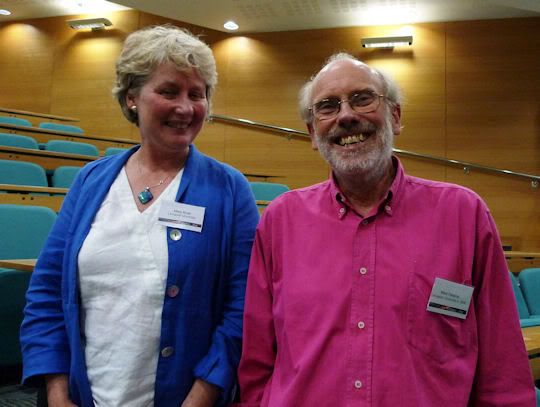
I’d like that thank Mary Rose and Mike Parsons (below) for inviting me to innov_ex and for looking after me so well. It was fascinating and very enjoyable.
I’ll be back next year and looks like I might be a little more involved as a competition judge. I know some of the points regarding environmental impact discussed at the conference will be applied to next years conference, so it’s evolving which keeps it relevant. I’ll be watching the build-up with interest.